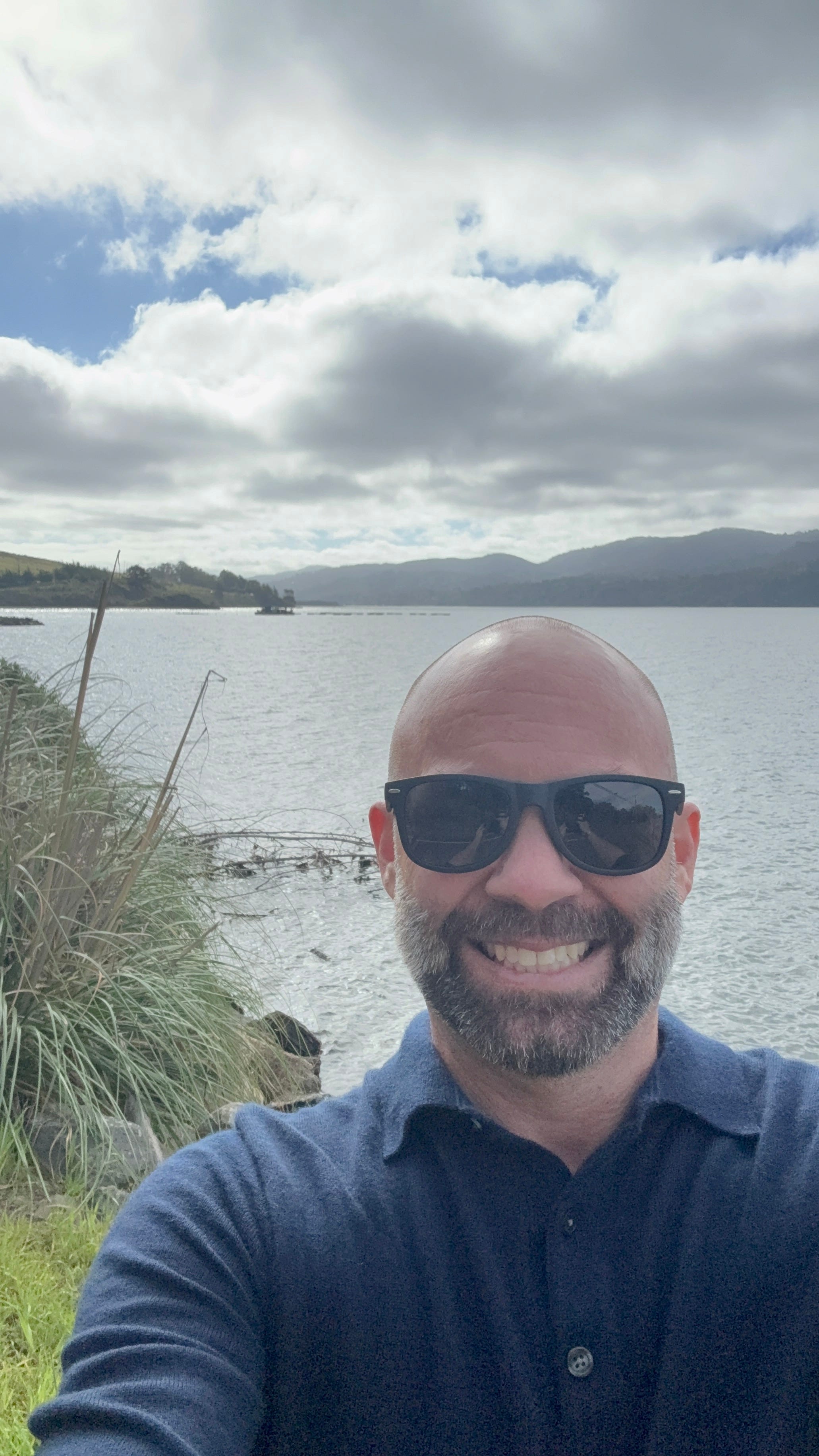
A Place Built for Reaching
On land shaped by signal, community, and story

I arrived around 3:30 yesterday afternoon at the Marconi Conference Center in Marshall, CA, about 3 hours west of Sacramento. The drive in was amazing as always.
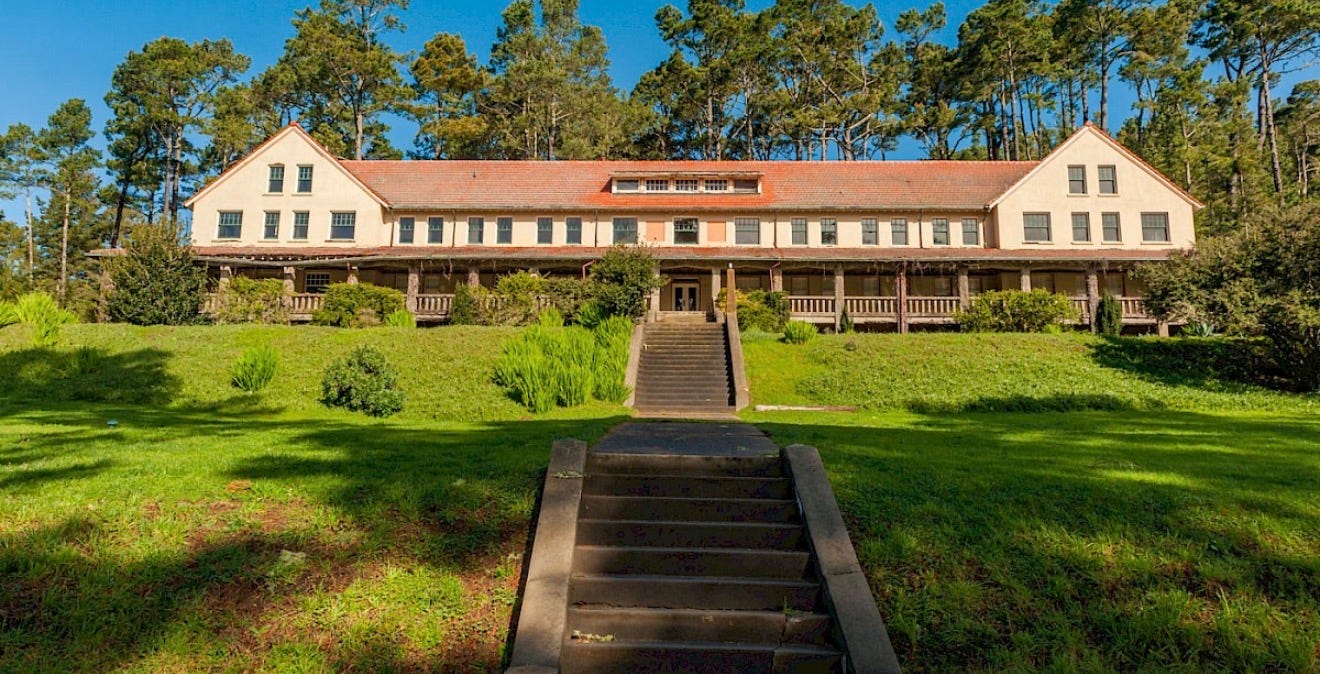
(Photo credit visitmarin.org)
I was there to give the capstone talk for a statewide training of the people who help guide how interpretation works across California State Parks, the folks responsible for thinking about how visitors connect with place.
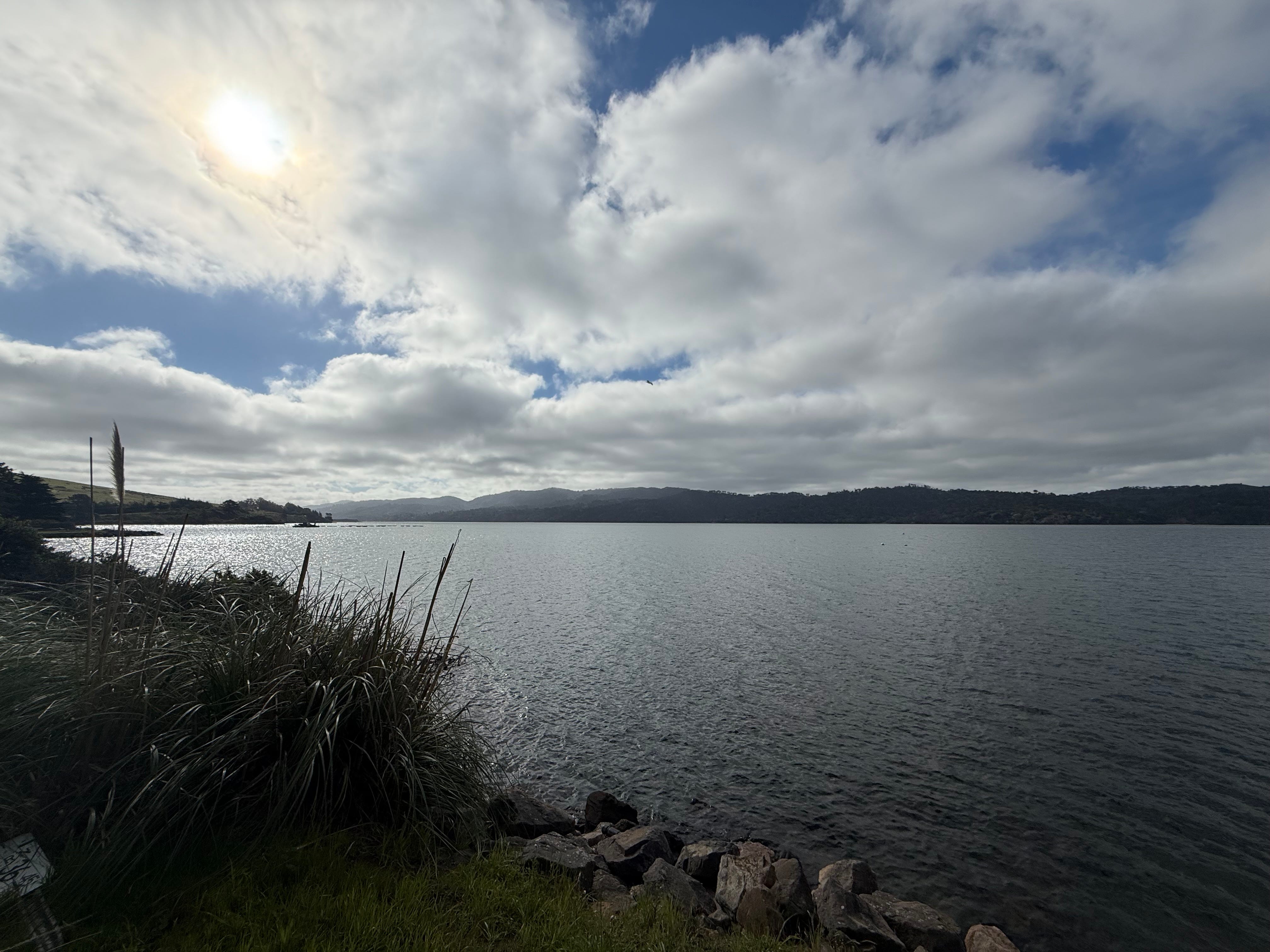
The site sits above Tomales Bay and the view is unbelievable.
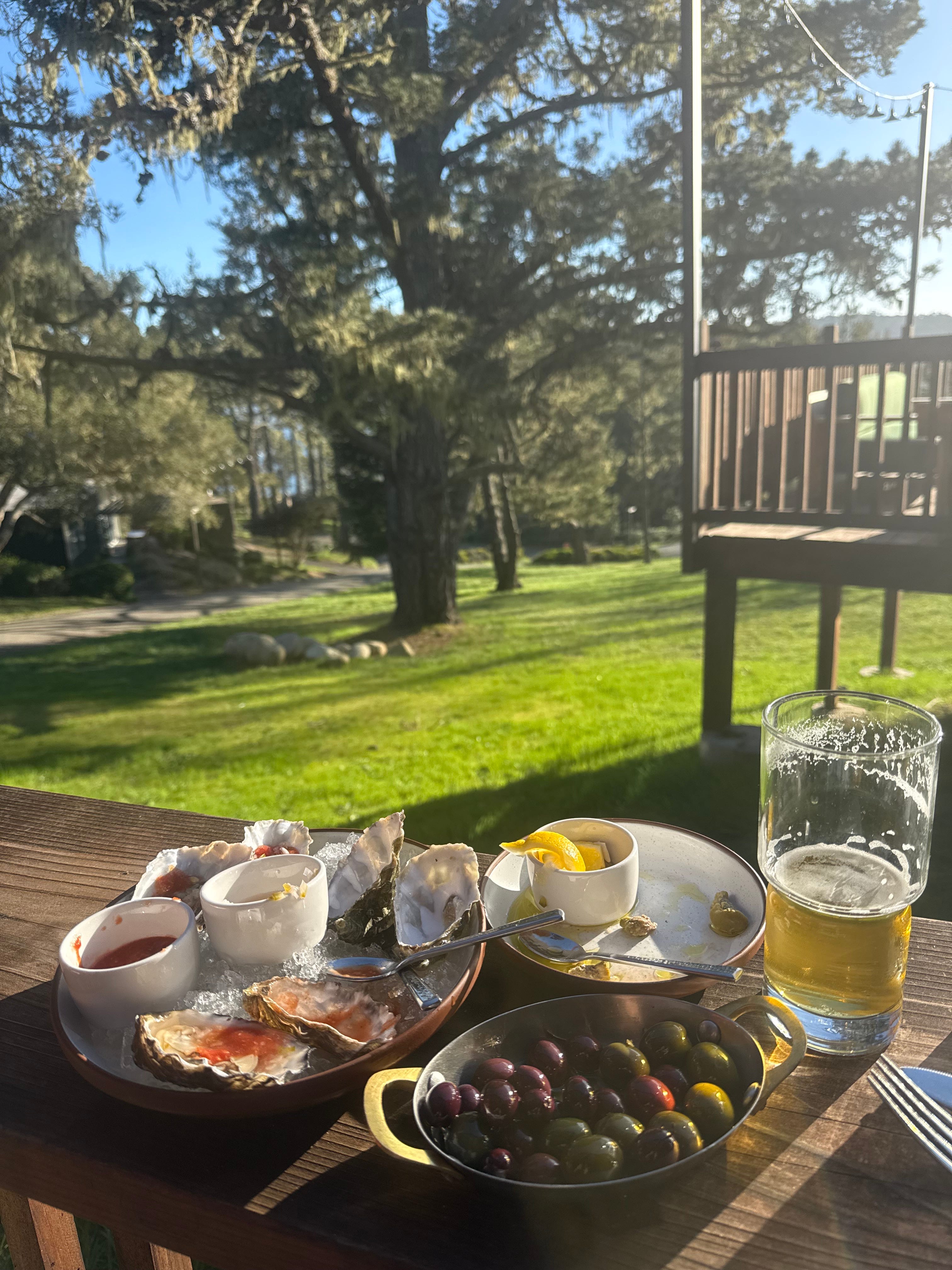
I stopped at Mabel’s on the Hill. Happy hour. Local oysters — six for twelve dollars! Marinated olives and a perfectly hopped lager from Lost Coast Brewing. These are the kinds of quiet rituals that always make me feel like I’ve arrived somewhere rather than just checked in.
From there, I made my way back up the hill to the grounds.
The property isn’t organized around a single central lodge. It’s a network of buildings set across the hillside, connected by paths rather than corridors. You move between them across open space along routes that make interaction possible without demanding it.
Mine was Building 3.
Like the others, it sits within the slope rather than on top of it. It was on that walk across the grounds that I started to notice something I couldn’t quite name. Not just age. Presence maybe. I know that sounds like stinky cheese. But genuinely, I couldn’t quite put my finger on it.
When I arrived to my room, there was a small green book on the desk, the kind that looked like it might have been printed sometime in the mid to late 1980s, sitting next to an old rotary phone that probably once connected guests to the front desk but now was reduced to being a reminder of when times were simpler.
The book briefly mentioned the wireless transmission station that once stood here. That caught my attention. So I opened my laptop and started looking into the place. I knew it had history, but I didn’t understand the whole shape of it. What I found came in layers.
First, that long before any buildings, this was home to Miwok communities who lived along the bay, fishing its waters, moving seasonally across the land, shaping it through practices that were relational rather than extractive.
Then, in the early 1900s, the Marconi Wireless Telegraph Company built a transmission station here. Tall towers once stood on this hillside. From this place, messages were sent across the Pacific. Ships could be reached from shore. Distance became something you could negotiate.
Later still, the site became home to Synanon. What began as a drug rehabilitation community eventually evolved into what many would later describe as a cult structured around shared living, constant interaction, and eventually, increasing control. By the 1980s, Synanon collapsed.
The property eventually passed into public hands and became part of California State Parks.
Now, anyone can come here. Walk the trails. Look out over Tomales Bay. Sit with the quiet.
And in reading through all of that history, I started thinking about my next piece. It’s been a minute since I wrote something for me. So much of my work lately has been about frameworks, policy, guidance. I realized I’d almost forgotten what I enjoy most: Telling stories.
This felt like one worth telling.
The supervisor who invited me had texted earlier asking me to come down to the Buck Hall and meet the group. From the moment I arrived, the welcome from the whole crew was easy, genuine and unforced.
After dinner, everyone drifted outside to the open space at the center of the grounds, where a fire pit was already going.
Eventually, someone brought out a guitar. A solid nylon-string Yamaha. I had that quick internal thought: didn’t the Barbie movie kind of kill this whole campfire guitar moment? But nobody else seemed bothered. They were just playing. And that was enough. So I leaned in.
“Alright then. Hand me that axe.”
I’m not Jimi Hendrix but not a campfire liability either. It turned into one of those organic jam sessions where no one was trying to impress anyone, just building something together for a while: music and good conversation.
But all things in moderation, so around 10, I slipped out to my lodge to edit a few slides for the morning. It was the right choice to leave the group for at least two reasons. I didn’t want to be an imposition, and my subconscious must have known that my anxiety would get the best of me because at 5:15 in the morning, I was definitely not going back to sleep. The three ring circus in my head started doing its thing: Oompah! Honk! Ta-da! Wheee! Ba-dum-tss! Ding-ding! Whoosh! Pop! I waited until the sun barely started to show itself and got up, put my jacket on over my pajamas, laced up my sneakers, and went for a walk to gather my thoughts. After all, my presentation wasn’t until nine.
After the walk, I headed back to my room, made some tea, dressed slowly, ran through some rehearsal, and made my way down to the session space.
I set up my laptop about twenty minutes early. Tested everything. It worked.
Right as I was about to begin at 9:03…the projector went out.
We diagnosed and eventually figured it out. Of course there was a moment of a few chuckles (that shared recognition) that the person there to talk about learning in the age of AI had just been sidelined by the most ordinary form of technological failure. Completely appropriate (fortunately, I think the fire pit and the guitars the night before had already done some quiet work for me).
Lucky for me, there was grace in the room, an understanding that sometimes the tools don’t cooperate. We go on anyway.
Let’s back up…
I wasn’t there to introduce experiential learning to these folks. Or even really to talk about AI. Sure, it’s in the title of my session. But those who know me know my work isn’t about usage. It’s about impact.
And experiential learning? This is their lane. These people already work inside it. They’re the professionals. If anything, I’m the amateur.
So who was in the room? This was a gathering of state leaders, the people responsible for guiding interpretive strategy, staff development, and visitor experience across park districts. people responsible for helping visitors experience California’s parks in ways that are felt, not just understood. These are the educators who create aesthetic learning experiences every time a person visits a California state park.
If you’ve ever visited one of California’s state parks, you probably remember an experience that stayed with you. I remember going to Sutter’s Fort in the fourth grade. My family had just moved from New York and I can’t tell you much of anything that happened from k-3rd grade, but I can tell you that I remember that field trip to Sutter’s Fort. In fact, I don’t remember a thing from 4th grade, hell, perhaps my entire elementary school experience is a blur, but I remember that trip to Sutter’s Fort. You know why? Because I remember the feeling of being there.
That didn’t happen by accident. Someone helped create that moment. Someone chose the story. The framing. The questions. The way the past shows up in the present. That’s interpretation. Not just delivering information, but shaping an experience where something shifts while you’re in a place. That’s who’s in the room. And, the people in the room already know this. This is their craft for crying out loud!
So I started small:
A simple divergent thinking exercise: how many uses can you imagine for a paperclip? Not aiming for correctness. Just quantity.
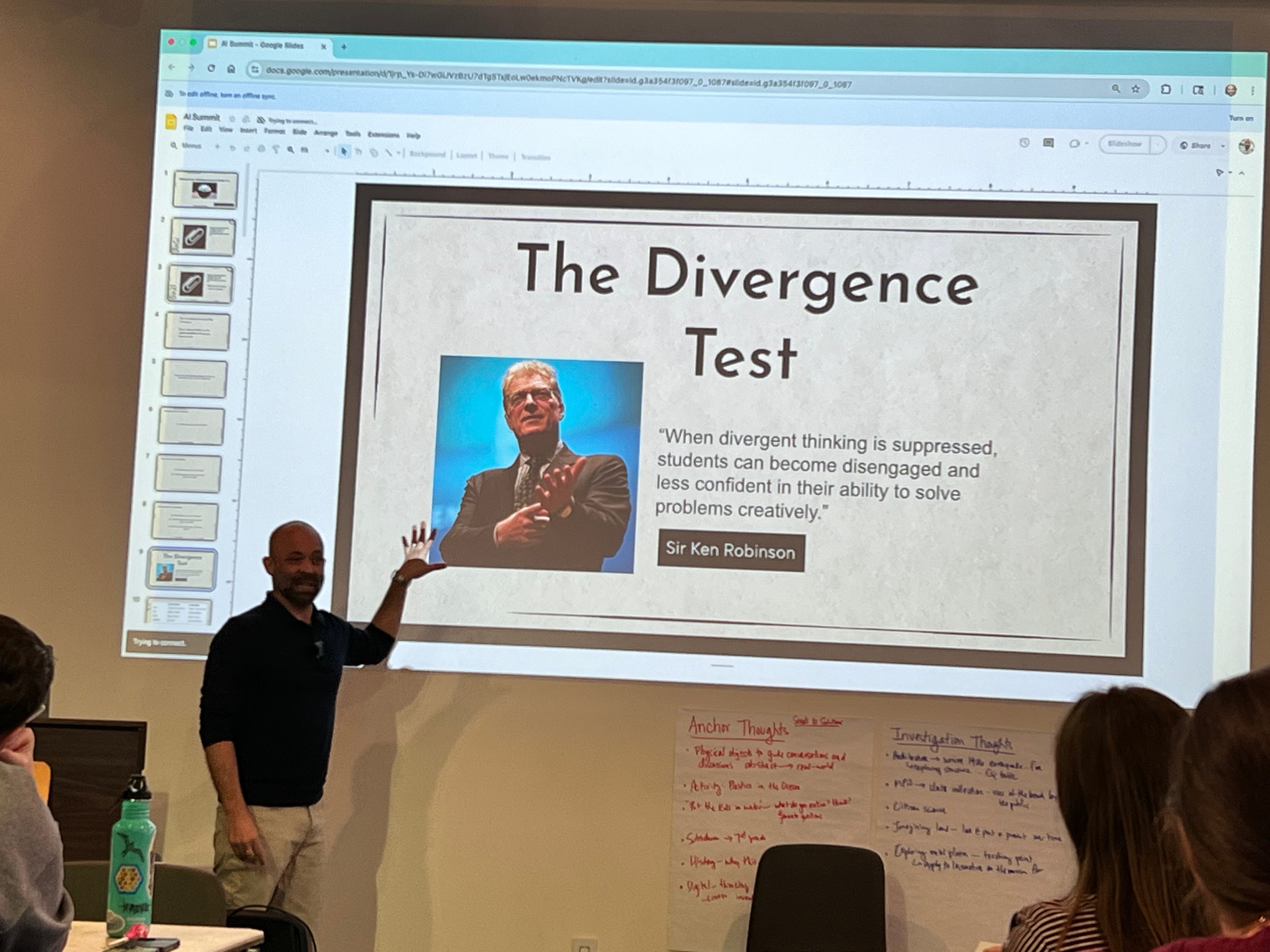
From there, we moved toward something they recognized immediately: Outcomes and learning aren’t the same thing. In a world where AI can generate polished products, the question becomes less about what someone produces…and more about how they arrived there.
At one point I mentioned to them:
If you swap “teacher” for “interpreter,” this model probably describes your job better than mine.
There was recognition in the room. Because interpretation has always lived in the process. At the end of the session, the director smiled and said simply, “That went well” with a big grin ear to ear. Truth be told: sometimes that’s enough.
…
This hillside has seen many ways people have tried to reach one another. Across water, systems, communities. Across pain. Across change. Toward reinvention. That’s what I’m hoping for in the autumn of my teaching career.
This time, it was through conversation, and I’m going to treasure that experience.
Somewhere in the middle of all of this, I remembered something. Storytelling is just another way we try to reach each other.
I like doing that.